Learn the difference between T raises and Y raises, including how each exercise emphasizes different scapular muscles to support shoulder blade control, upper-back strength, and shoulder function.
T Raise vs. Y Raise: What’s the Difference for Shoulder Strength?
The T raise and Y raise may look very similar, but changing the position of your arms changes the muscular emphasis of the exercise.
Both exercises can be used as part of shoulder rehabilitation and strengthening, particularly when working on scapular control, upper-back strength, and more controlled shoulder movement.
The main difference?
The Y raise places greater emphasis on the lower trapezius, while the T raise places greater emphasis on the rhomboids and mid-back muscles involved in scapular retraction.
Understanding that difference can help explain why your physiotherapist may choose one variation over another.
What Is a Y Raise?
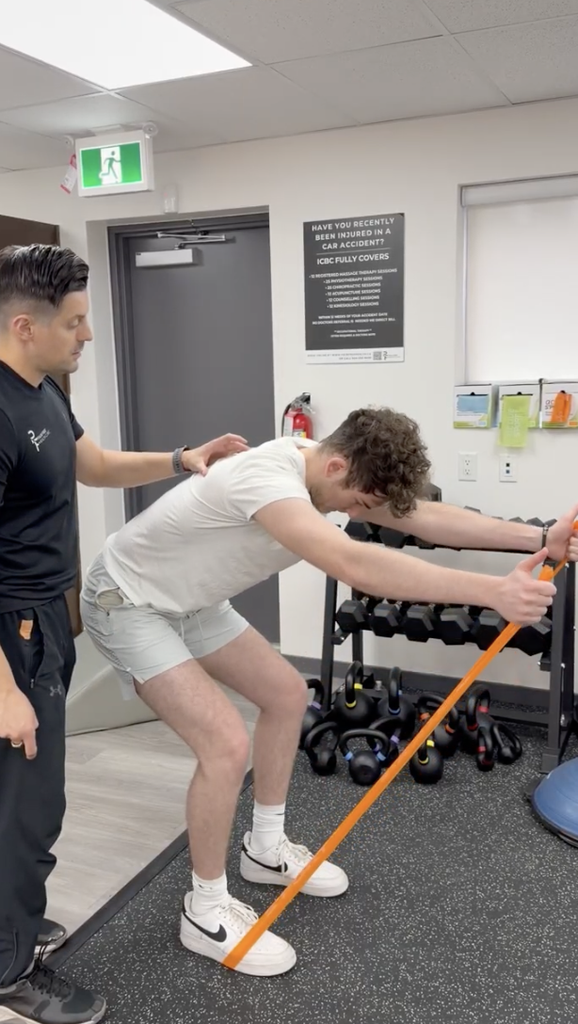
A Y raise involves lifting the arms upward and outward so the arms form a “Y” shape with the body.
This position places greater emphasis on the lower trapezius, a muscle that plays an important role in controlling the shoulder blade during movement.
A simple cue during the exercise is:
Shoulder blade down + back
Rather than simply lifting the arms as high as possible, the focus should be on maintaining controlled movement through the shoulder blades.
What Is a T Raise?
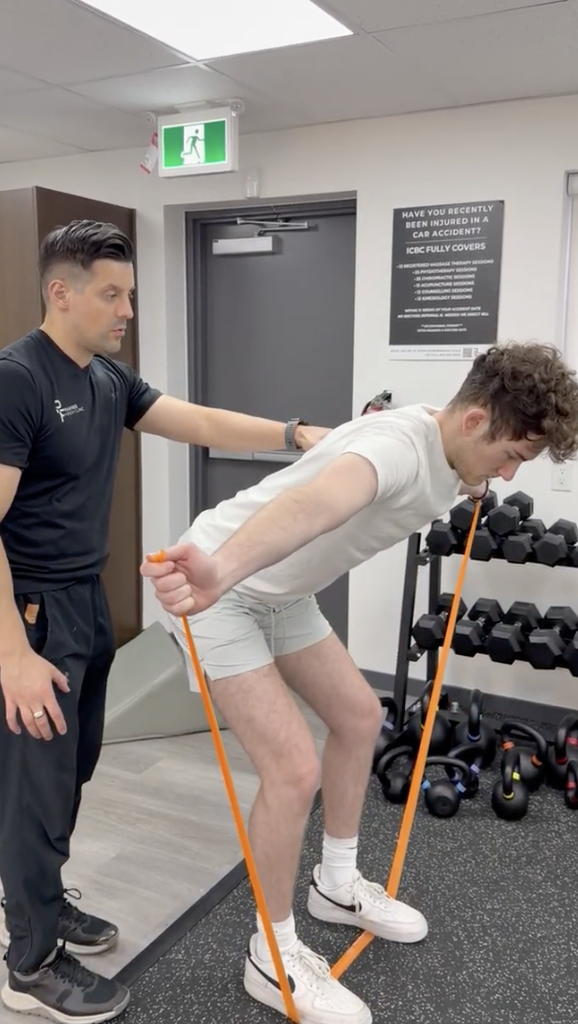
A T raise uses a similar starting position, but the arms move outward to form a “T” shape with the body.
This change in arm angle places more emphasis on the rhomboids and mid-back, while other muscles around the shoulder and upper back also contribute to the movement.
A common cue is:
Squeeze the shoulder blades together
The T raise can be incorporated into exercises designed to develop scapular retraction and upper-back strength.
T Raise vs. Y Raise: Which Muscles Do They Emphasize?
Although both exercises involve the shoulder blades and surrounding musculature, their different arm positions change the muscular emphasis.
Y Raise:
→ Greater lower trapezius emphasis
→ Trains scapular control
→ Supports controlled shoulder movement
T Raise:
→ Greater rhomboid and mid-back emphasis
→ Trains scapular retraction
→ Helps develop upper-back strength
In simple terms:
Different arm angles = different scapular muscle emphasis.
Neither exercise is automatically better. The appropriate exercise depends on what you're trying to improve and your individual rehabilitation needs.
Why Is Scapular Control Important?
Your shoulder blades, or scapulae, provide an important base for shoulder movement.
When you reach, lift, push, pull, or move your arms overhead, several muscles around the shoulder blade work together to control its position and movement.
Exercises such as T raises and Y raises may be incorporated when working on:
The goal isn't simply to move your arms through the exercise. How you control your shoulder blades throughout the movement matters.
Should You Do T Raises or Y Raises?
The right choice depends on what you're trying to improve.
If the goal is to place greater emphasis on the lower trapezius and scapular control, a Y raise may be considered.
If the goal is to emphasize scapular retraction and the rhomboids or mid-back, a T raise may be incorporated.
In some rehabilitation programs, both exercises may be used because they provide different muscular emphasis.
Exercise selection, technique, resistance, and progression should be based on your individual needs, symptoms, movement, and rehabilitation goals.
Need Help with Shoulder Pain or Shoulder Strength?
If recurring shoulder discomfort, weakness, or difficulty with movement is affecting your work, exercise, or everyday activities, a physiotherapy assessment can help determine what may be contributing to the problem and which exercises may be appropriate for you.
📍 Richmond
📍 Ladner
📍 Surrey
📍 Langley
Watch the Video
Watch the video above to see the T raise vs. Y raise side by side and learn how changing the arm angle can change the muscular emphasis around the shoulder blade and upper back.
Learn More About Shoulder Exercises and Physiotherapy
Follow Pain Free Health Clinic on YouTube, Instagram, Facebook, and TikTok for more educational content on shoulder exercises, T raises, Y raises, scapular control, lower trapezius strengthening, rhomboid exercises, upper-back strength, shoulder rehabilitation, shoulder pain, and physiotherapy to help you move with confidence.


