Adhesive capsulitis, more commonly known as frozen shoulder, is one of those conditions where the textbook picture and the real-world presentation don't always line up. Early on, it's easily mistaken for a rotator cuff problem. By the time it's obvious, the patient has often been dealing with months of pain and stiffness. Understanding the stages, and how the pattern of movement loss evolves through them is key to getting the physiotherapy approach right at each point.
What's Actually Happening
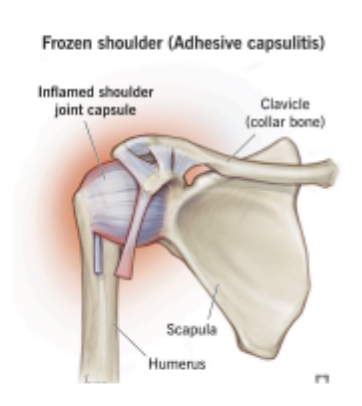
Adhesive capsulitis involves progressive fibrosis and thickening of the glenohumeral joint capsule, particularly around the coracohumeral ligament and rotator interval. As the capsule tightens, it produces a characteristic capsular pattern of restriction, both active and passive range of motion become limited, following a predictable sequence rather than affecting all movements equally. It's more common in women aged 40–60 and has a well-established association with diabetes, thyroid disorders, and periods of prolonged shoulder immobilization, such as after a fracture or stroke.
The Capsular Pattern: Which Movements Go First
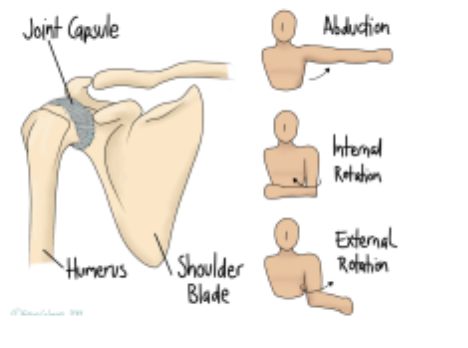
The order of movement loss is remarkably consistent:
1. External rotation: lost first, and often most severely restricted
2. Abduction:lost next, as the condition progresses
3. Internal rotation: typically the last movement affected, though ultimately still restricted
This ER > abduction > internal rotation pattern is one of the most useful clinical clues for differentiating adhesive capsulitis from other causes of shoulder pain and restriction, like rotator cuff pathology, which doesn't follow this same proportional pattern.
The Four Stages
Stage 1: Pre-freezing (0–3 months): Pain is often vague and intermittent, worse with movement, and frequently disproportionate to what you'd expect from the exam findings. Range loss is subtle at this point, but external rotation is usually the first sign, even mild ER restriction here can be an early clue, though it's often mistaken for pain-guarding rather than true capsular tightening. Underlying synovitis (inflammation) is present, but capsular fibrosis hasn't set in yet.
Stage 2: Freezing (3–9 months): This is where the condition becomes unmistakable. Pain worsens, often including significant night pain, and abduction becomes noticeably restricted alongside a worsening loss of external rotation. Internal rotation may begin to show some limitations too, though it typically lags behind. Synovial inflammation is progressing into capsular fibrosis, and patients often describe this as the most debilitating phase.
Stage 3: Frozen (9–15 months): Pain often begins to settle, particularly at rest, but stiffness is now at its worst. Internal rotation restriction becomes fully apparent, completing the classic ER > abduction > internal rotation pattern. All three movements are significantly limited, both actively and passively, and functional tasks like reaching overhead or behind the back become genuinely difficult. By this stage, synovitis has largely resolved, leaving dense capsular fibrosis as the main driver of restriction.
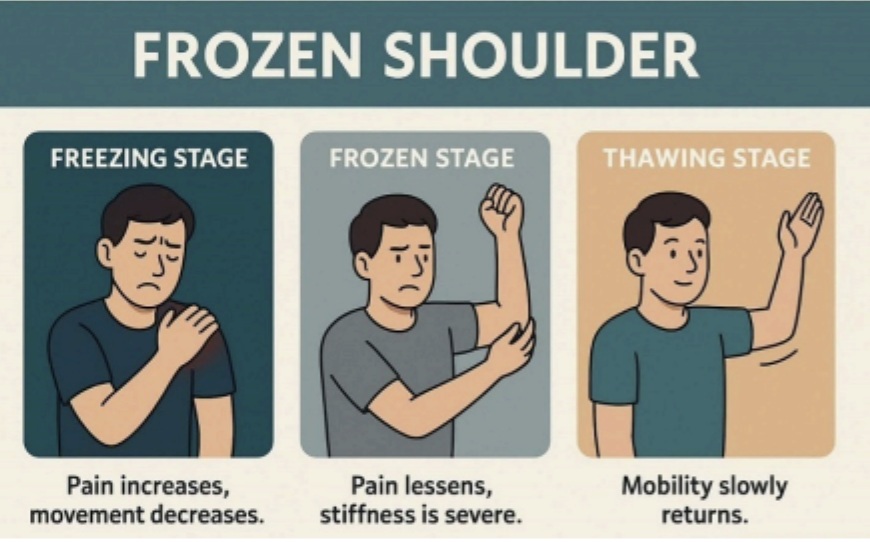
Stage 4: Thawing (15–24 months): Range of motion gradually improves, generally in the reverse order it was lost: internal rotation and abduction tend to recover first, while external rotation is often the slowest and most incomplete to return. Pain continues to ease throughout this stage, though recovery can be slow, and a subset of patients are left with a mild residual ROM deficit even once things have largely resolved.
How Physiotherapy Fits at Each Stage
This is where staging really earns its keep clinically, the right approach in one stage can actively aggravate symptoms in another.
Stage 1 (Pre-freezing): Pain management and education: Since pain often outweighs objective restriction here, aggressive stretching isn't the priority. Gentle range-of-motion work, activity modification, and patient education about the expected trajectory of the condition are more appropriate. This is also the stage where corticosteroid injections tend to be most effective, since synovitic inflammation is still the dominant driver.
Stage 2 (Freezing): Gentle, pain-guided mobility work: As stiffness accelerates, the temptation is to push range aggressively, but this stage is highly reactive, and overly forceful stretching can flare symptoms and increase guarding. A gentler approach, pain-free range of motion, capsular mobilizations within tolerance, and continued education, tends to be better tolerated. Addressing sleep positioning and night pain becomes a bigger focus here too.
Stage 3 (Frozen): More assertive mobilization and stretching: With pain settling and stiffness now the dominant issue, patients generally tolerate firmer joint mobilizations and stretching far better than in Stage 2. This is where physiotherapy can have its biggest functional impact, targeted capsular stretching, joint mobilizations addressing the specific ER/abduction/IR restrictions, and progressive strengthening of the surrounding shoulder girdle musculature to offset the period of disuse. For patients who plateau despite consistent rehab, this is also the stage where hydrodilatation, manipulation under anaesthesia, or arthroscopic capsular release may be considered.
Stage 4 (Thawing): Progressive loading and functional restoration: As range of motion begins recovering, physiotherapy shifts toward reinforcing that recovery, progressive stretching to encourage full return of motion (particularly external rotation, which lags), strengthening to rebuild capacity lost during the frozen stage, and functional retraining for tasks like overhead reaching. Since external rotation is often the slowest to normalize, it may need continued, targeted attention even after the patient feels largely "recovered."
The Takeaway
Adhesive capsulitis isn't a single, static condition, it's an evolving process, and treating every stage the same way misses the point. Recognizing where a patient sits within the ER-first, abduction-next, internal-rotation-last pattern doesn't just help confirm the diagnosis, it directly shapes whether the right move is to calm things down or push them forward. Getting that timing right is often what separates a frustrating plateau from real functional progress.


