Finding it harder to grip or hold things for long? Learn how simple hand-strengthening exercises can help target the muscles involved in grip, finger control, and everyday hand function.
Struggling to Grip or Hold Things for Long? Try These Simple Exercises
Holding your phone, carrying a cup of coffee, picking up a bowl, holding your baby, or opening everyday items all require hand and grip strength.
When your hands feel weak or tire easily, even simple daily activities can become more difficult.
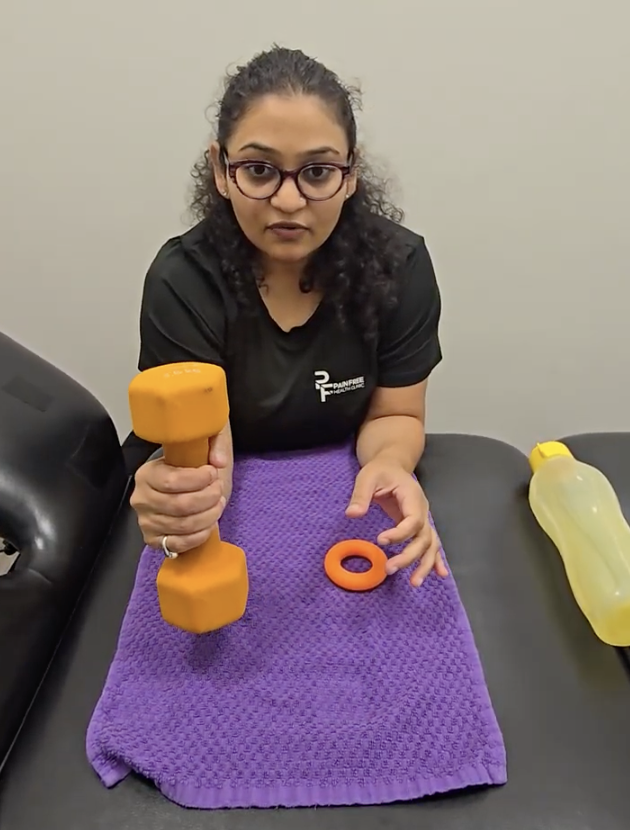
The good news is that hand strengthening doesn't always require complicated equipment. Depending on your needs and current ability, simple items you already have at home—such as a towel, water bottle, or dumbbell—can be incorporated into strengthening exercises.
Why Is Hand and Grip Strength Important?
Your hands are involved in countless activities throughout the day.
Grip strength allows you to securely hold and control objects, while the smaller muscles within your hands help with more precise movements and coordination.
The intrinsic muscles of the hand are small muscles located within the hand itself. They contribute to finger movement, control, coordination, and grip.
When these muscles become weak or have reduced capacity, you may notice everyday tasks becoming more challenging.
Simple Ways to Work on Hand Strength
You don't necessarily need specialized rehabilitation equipment to challenge your hand muscles.
Depending on your ability, exercises may incorporate everyday items such as:
The goal is to provide an appropriate challenge to the muscles involved in hand and grip function.
The amount of resistance and type of exercise should match your current strength, symptoms, and rehabilitation needs.
How Can Better Grip Strength Help With Daily Activities?
Hand strengthening isn't only useful for sports or gym activities. Your grip is constantly being used throughout everyday life.
Holding Your Phone
Holding a phone for extended periods requires your fingers and hand muscles to maintain a steady grip.
If your hands fatigue easily, this seemingly simple activity may become uncomfortable or difficult over time.
Carrying Cups and Bowls
Your grip helps you securely hold objects such as a cup of coffee, glass of water, plate, or bowl of food.
Improving hand strength and control can support your ability to manage these everyday objects.
Holding Your Baby or Child
Holding and carrying a baby requires sustained effort from your hands, wrists, forearms, and upper extremities.
Appropriate strengthening may help build the capacity needed for these repeated daily demands.
Everyday Household and Work Tasks
Opening containers, carrying groceries, using tools, preparing food, typing, and handling objects at work can all depend on adequate hand strength and coordination.
This is why improving hand function can have benefits that extend well beyond exercise.
Why an Individual Assessment Matters
Not every case of reduced grip strength has the same cause.
If you're experiencing difficulty gripping or holding objects, relevant factors may include:
An assessment can help identify which areas may need attention and which exercises are appropriate for your individual situation.
This is particularly important if weakness is new, persistent, worsening, or accompanied by other symptoms.
Should You Just Keep Increasing the Resistance?
More resistance isn't always better.
Hand-strengthening exercises should be appropriate for your current ability, symptoms, and goals. Someone recovering from an injury may require a very different progression than someone simply looking to improve general hand strength.
Exercises can be gradually progressed as your strength, control, and tolerance improve.
If an exercise causes significant pain or aggravates existing symptoms, it may need to be modified or reassessed.
Are Hand-Strengthening Exercises Right for You?
If you've noticed that your grip isn't as strong as it used to be, strengthening exercises may be one part of improving your hand function.
However, persistent pain, weakness, numbness, tingling, loss of coordination, or difficulty holding objects shouldn't automatically be assumed to be caused by weak hand muscles.
Understanding what's contributing to your symptoms can help determine the most appropriate next step.
Need Help Improving Your Hand & Grip Strength?
At Pain Free Health Clinic, we believe rehabilitation should reflect your symptoms, current abilities, everyday demands, and individual goals.
If hand weakness or difficulty gripping is affecting your daily activities, our team can assess your function and help determine which exercises and rehabilitation strategies may be appropriate for you.
📍 Richmond
📍 Ladner
📍 Surrey
📍 Langley
Watch the Video
Watch our hand-strengthening video to see simple exercises using a towel, water bottle, and dumbbell and learn how they can be used to work on the muscles involved in grip and everyday hand function.
Learn More About Hand & Grip Strengthening
Follow Pain Free Health Clinic on YouTube, Instagram, Facebook, and TikTok for more educational content on hand strengthening, grip strength, physiotherapy, injury rehabilitation, mobility, and active recovery.


