Want to build stronger hamstrings and improve lower-body strength? Learn how five exercises, including banded hamstring curls, plank leg raises, glute bridge walkouts, elevated glute bridges, and Nordic lowers, can help you work on strength, control, and movement capacity.
Want Stronger Hamstrings? Here Are 5 Exercises to Add to Your Routine
Your hamstrings play an important role in everyday movement and physical activities.
Located at the back of your thighs, these muscles help bend your knees and contribute to hip movement during activities such as walking, running, jumping, and lifting.
Building hamstring strength can help prepare your body for the demands of physical activity. However, no exercise can completely prevent injuries, and an appropriate training program depends on your current ability, activity level, and individual goals.
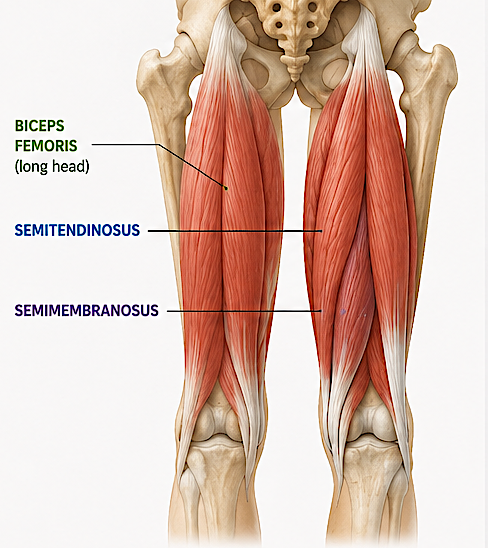
These five exercises focus on hamstring strength, lower-body control, and supporting muscle groups.
1. Banded Hamstring Curl
Banded hamstring curls focus on the muscles at the back of your thighs by adding resistance as you bend your knees.
The resistance band provides a way to adjust the challenge based on the band's tension and your current strength.
Focus on performing each repetition slowly and maintaining control as you bend and straighten your knees.
What to Focus On:
2. Plank Leg Raise
The plank leg raise challenges your core stability while adding a leg movement that requires control through your hips and supporting leg.
Depending on the variation, this exercise can involve your glutes, core, and other muscles that help stabilize your body.
Although it isn't a direct hamstring isolation exercise, it can complement a broader lower-body strengthening routine.
What to Focus On:
3. Glute Bridge Walkout
The glute bridge walkout builds on the traditional glute bridge by adding a controlled stepping movement with your feet.
As your feet move farther away from your body, your hamstrings are challenged to help control the position of your hips.
This exercise also involves your glutes and trunk muscles, making it a useful option for developing lower-body control.
What to Focus On:
4. Elevated Glute Bridge
The elevated glute bridge involves placing your feet on a raised surface while performing a bridge.
This changes the position of your hips and knees and can alter how your glutes and hamstrings contribute to the movement.
The level of difficulty depends on the height of the surface, your body position, and your current strength.
What to Focus On:
5. Nordic Lower
The Nordic lower is a hamstring exercise that emphasizes controlling the lowering phase of a movement.
It can place a substantial demand on the hamstrings, so it may be more challenging than the other exercises in this routine.
If you're new to Nordic exercises, start with an appropriate assisted variation and progress gradually as your strength improves.
What to Focus On:
How Can You Build Stronger Hamstrings?
Adding exercises to your routine is one part of building strength. How you perform and progress them also matters.
Focus on Technique
Good technique helps you perform exercises with control and target the intended movement patterns. Choose variations you can complete without forcing uncomfortable positions.
Progress Gradually
As an exercise becomes easier, you may be able to increase resistance, repetitions, range of motion, or difficulty. Change one factor at a time and allow your body to adapt.
Allow Time for Recovery
Your muscles need time to recover between challenging sessions. Adjust your training based on your activity level, soreness, and overall recovery.
Train More Than One Movement Pattern
A balanced lower-body program may include hamstring exercises, glute strengthening, knee-dominant movements, and exercises that develop balance and control.
Remember That Stronger Hamstrings Don't Guarantee Injury Prevention
Hamstring injuries can occur for different reasons, particularly during activities involving sprinting, acceleration, and rapid changes in speed.
Strength training can be part of a broader conditioning program, but these five exercises alone cannot guarantee injury prevention.
Your training should reflect your sport or activity, current strength, previous injuries, and individual needs.
How Can Physiotherapy Help With Hamstring Strength?
If you're experiencing hamstring discomfort, recurring tightness, weakness, or difficulty returning to exercise after an injury, a physiotherapist can assess your symptoms, strength, movement, and activity demands.
Depending on the assessment findings, your rehabilitation plan may include progressive strengthening, mobility exercises, movement retraining, and a gradual return to your usual activities.
The appropriate exercises and progression will depend on your individual presentation rather than a one-size-fits-all routine.
Need Help With Hamstring Strength or Lower-Body Rehabilitation?
At Pain Free Health Clinic, we believe your rehabilitation should reflect your symptoms, movement, current abilities, and individual goals.
Our physiotherapy team can assess your movement and strength and help determine whether progressive strengthening, exercise therapy, or other rehabilitation strategies may be appropriate for you.
📍 Richmond
📍 Ladner
📍 Surrey
📍 Langley
Watch the Video
Watch our hamstring exercise video to see five movements that focus on hamstring strength, glute strength, and lower-body control.
Learn More About Strength & Physiotherapy
Follow Pain Free Health Clinic on YouTube, Instagram, Facebook, and TikTok for more educational content on hamstring exercises, hamstring strength, lower-body workouts, injury rehabilitation, physiotherapy, and movement health.


