Struggling with knee pain? Learn how Clinical Pilates and reformer-based exercises can help improve knee strength, movement and function with controlled, progressive loading at Pain Free Health.
Knee pain can make everyday activities such as walking, climbing stairs, getting out of a chair and exercising much more difficult. One of the challenges during knee rehabilitation is finding a way to strengthen the muscles around the knee without asking the joint to tolerate more load than it is ready for.
At Pain Free Health, Clinical Pilates can be incorporated into a physiotherapy rehabilitation program to help patients gradually rebuild strength, movement and confidence.
What Is Clinical Pilates?
Clinical Pilates uses Pilates-based exercises that are selected and modified according to an individual's injury, mobility and rehabilitation goals.
Unlike a general Pilates class, exercises used during rehabilitation can be adjusted by a healthcare professional based on factors such as pain, strength, range of motion, movement quality and tolerance to loading.
The Pilates reformer is particularly useful because its spring resistance and supported positions provide many options for modifying an exercise.
Why Can the Pilates Reformer Be Helpful for Knee Pain?
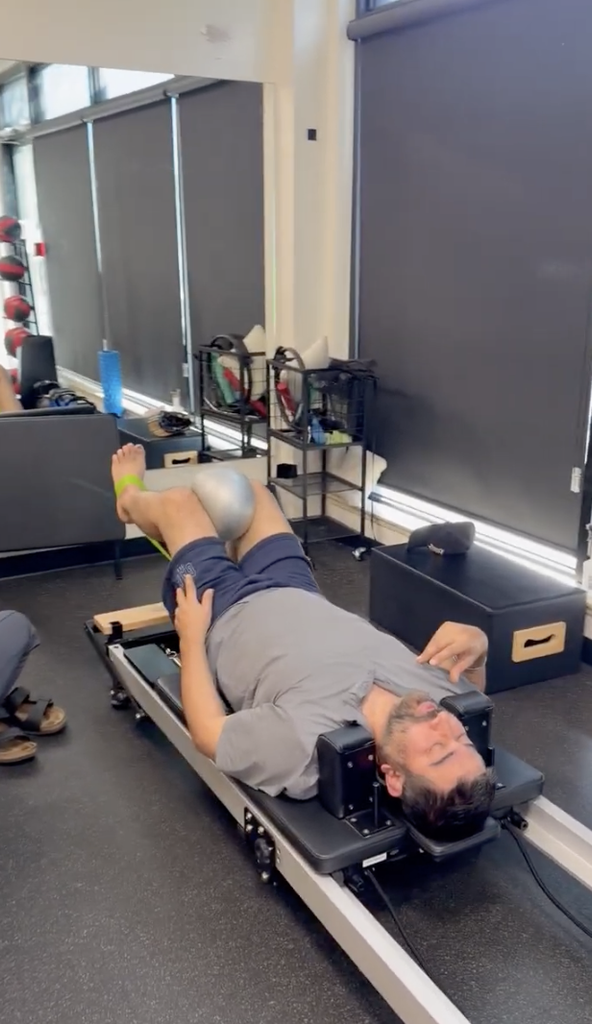
The exercise shown in our video is a good example.
Rather than immediately asking the patient to perform a full body-weight squat or lunge, the patient can work the legs against the resistance of the reformer while lying in a supported position.
This can allow us to work on the quadriceps, hamstrings, glutes and other muscles involved in controlling the hip and knee while adjusting the exercise to the patient's current abilities.
Importantly, the goal is generally not to permanently avoid weight-bearing. As symptoms and capacity improve, rehabilitation can progressively move toward greater resistance and more functional weight-bearing activities.
Who May Benefit?
Clinical Pilates may be useful as part of an individualized rehabilitation program for people experiencing knee pain associated with osteoarthritis, patellofemoral pain, muscle weakness, certain meniscus or ligament injuries, post-operative rehabilitation, or general deconditioning.
The appropriate exercises depend on the cause of the knee pain, so an assessment is important before deciding on a rehabilitation program.
From Supported Exercise to Everyday Movement
Ultimately, successful knee rehabilitation isn't just about performing an exercise on a reformer.
We want the strength developed during rehabilitation to transfer into real life — walking farther, using stairs, getting up from a chair, returning to work, exercising and participating in the activities you enjoy.
As the knee becomes stronger and more tolerant, exercises can be progressed toward increasingly challenging and functional movements.
Clinical Pilates at Pain Free Health
If knee pain is stopping you from exercising because traditional strengthening feels too uncomfortable, Clinical Pilates may provide another way to begin rebuilding your strength.
Our team at Pain Free Health can assess your knee, identify contributing factors and determine whether Clinical Pilates should be incorporated into your treatment plan.
Struggling with knee pain? Book an assessment with Pain Free Health and find out whether Clinical Pilates is right for your rehabilitation.


