Learn why back pain treatment should start with assessment and how percussive therapy may help with muscle soreness, stiffness, flexibility, and mobility as part of a broader recovery plan.
Back Pain? Don’t Just Chase the Sore Spot
When your back hurts, it can be tempting to immediately focus treatment on the first tight or sore area you find.
But back pain treatment shouldn’t start with guessing.
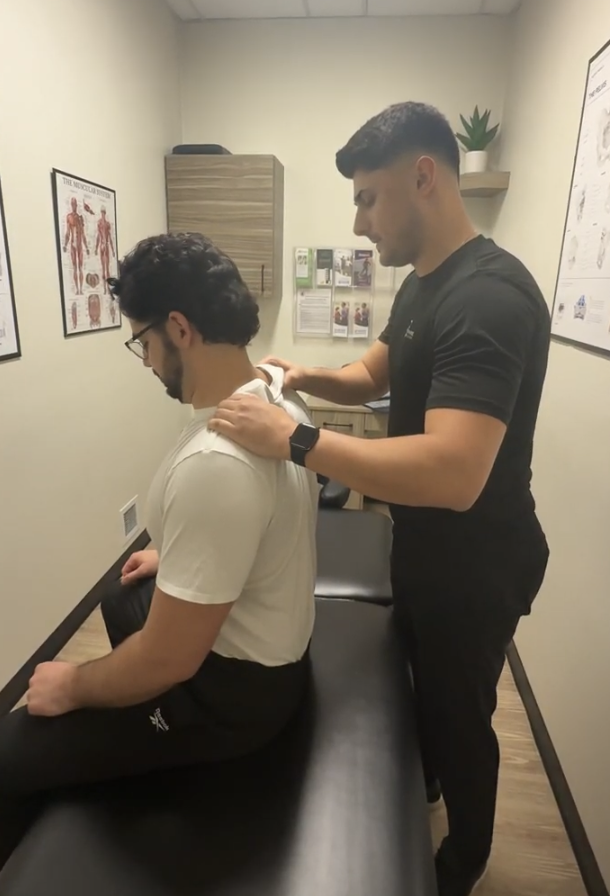
Before choosing a treatment technique, clinicians may first assess how the area feels, where symptoms are reproduced, how your body responds to pressure, and what movements affect your symptoms.
The information gathered during an assessment can then help guide where and how treatment is applied.
Why Assess Back Pain Before Treating It?
Back pain can present differently from person to person.
Before deciding which treatment approach may be appropriate, an assessment can help clinicians better understand:
Rather than simply finding a tight spot and immediately treating it, assessment provides information that can help guide the next step.
First: Assess. Then: Treat with purpose.
What Is Percussive Therapy?
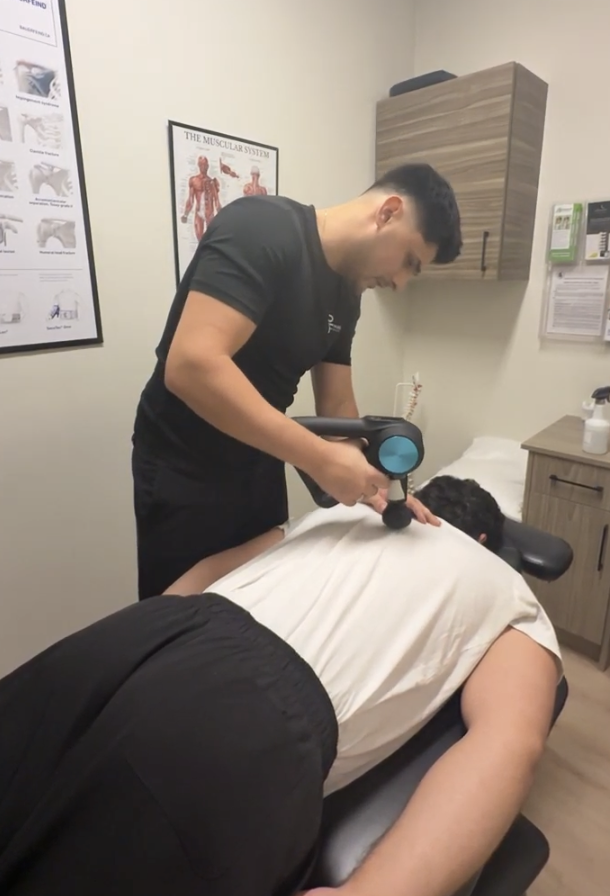
Percussive therapy uses a handheld device, such as a Theragun, to deliver repeated mechanical pressure to soft tissue.
When appropriate, it may be incorporated into treatment after assessment based on the individual’s presentation and needs.
The important distinction is that the Theragun is a tool—not the entire treatment plan.
What Are the Potential Benefits of Percussive Therapy?
Research suggests massage-gun and percussive therapy may provide some short-term benefits.
These may include:
However, the evidence is still limited and varies depending on the outcome being measured.
This is why percussive therapy should not automatically be used simply because an area feels tight or painful.
The Theragun Is the Tool. Assessment Guides How We Use It.
Treatment tools can be useful, but the tool itself does not determine what the body needs.
Assessment can help determine whether a technique is appropriate, where it should be applied, and how it may fit into the overall treatment approach.
The goal is not simply to chase every sore or tight spot.
It is to understand the person in front of us and use treatment appropriately based on what is found during the assessment.
Back Pain Treatment Can Involve More Than Passive Treatment
Percussive therapy may be one component of back pain care, but treatment does not necessarily end with a Theragun or another hands-on technique.
Manual and passive treatments can be incorporated alongside:
Assessment helps guide the treatment. Movement and active rehabilitation help build on it.
Assess → Treat → Move
When it comes to back pain, finding a sore spot is only part of the picture.
A hands-on assessment can provide information about sensitivity and how the area responds. From there, treatment tools such as percussive therapy may be incorporated when appropriate.
The Theragun is the tool. The assessment guides how we use it.
Back care should be more than just chasing the sore spot.
Need Help with Back Pain or Stiffness?
If you’re experiencing ongoing back pain, muscle soreness, stiffness, limited mobility, or discomfort with movement, an assessment can help determine what may be contributing to your symptoms and which treatment approaches may be appropriate for you.
📍 Richmond
📍 Ladner
📍 Surrey
📍 Langley
🌐 www.painfreehealth.ca
📞 (604) 553-8435
Watch the Video
See how hands-on assessment and percussive therapy may be incorporated into back pain treatment, and why assessment helps guide how treatment tools are used.
Learn More About Back Pain and Rehabilitation
Follow Pain Free Health Clinic on YouTube, Instagram, Facebook, and TikTok for more educational content on back pain, low back pain, back pain assessment, percussive therapy, muscle soreness, stiffness, mobility, physiotherapy, active rehabilitation, and movement to help you move with confidence.


